
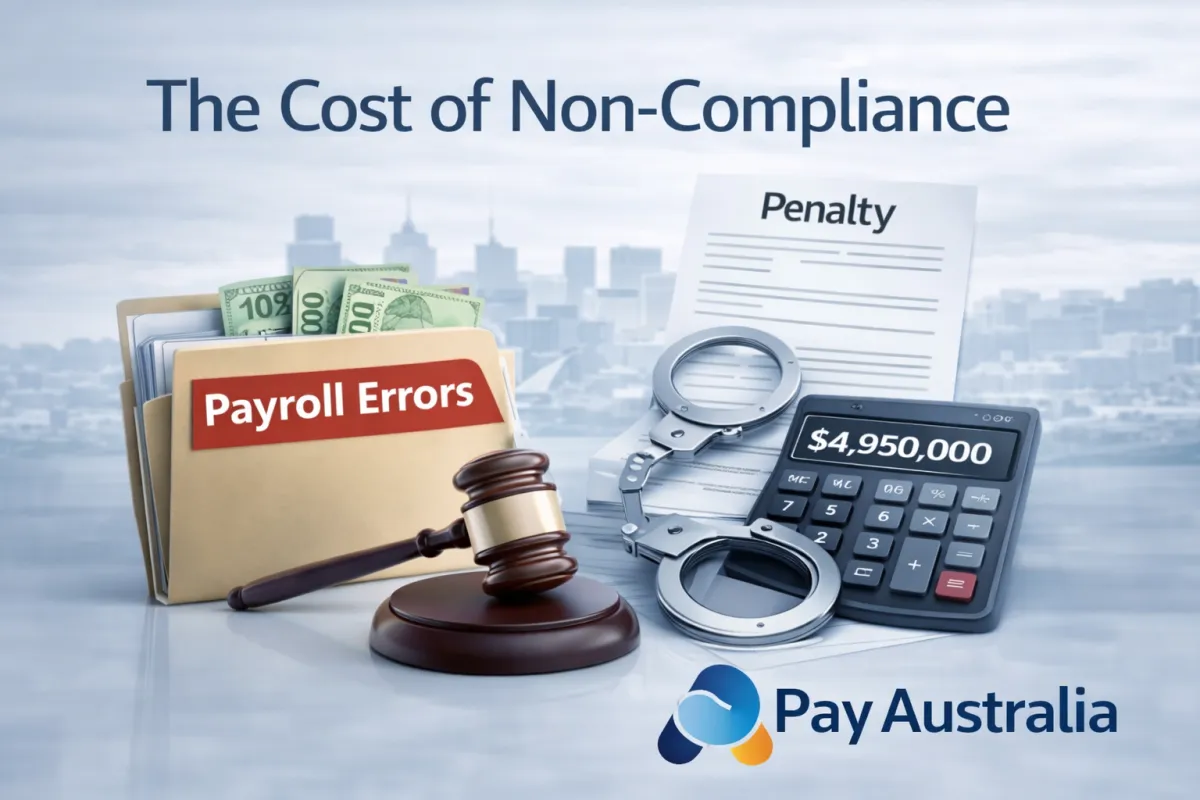
The Cost of Non-Compliance
The Cost of Non-Compliance - Financial Penalties, Public Scrutiny, and Workforce Trust Erosion
Non-Compliance Consequences
Payroll non-compliance carries devastating consequences: back-pay obligations, legal fees, and reputational damage that undermines employee trust and talent attraction. Since 1 January 2025, intentional wage underpayment has been a criminal offence, with penalties of up to $8.25 million for companies and 10 years' imprisonment for individuals, while even unintentional errors attract civil penalties of up to $495,000 per contravention. This zero-tolerance environment means compliance failures trigger financial devastation, Fair Work investigations, and public scrutiny that divert resources from growth. At Pay Australia, we take a proactive approach through comprehensive payroll audits and streamlined processes aligned with current legislation, transforming compliance from a legal burden into a strategic advantage that builds workforce loyalty and protects your business.
Payroll errors can have devastating consequences for Australian businesses. Underpayments lead to back-pay obligations, substantial penalties, legal fees, and lasting reputational damage that erodes employee trust and makes talent attraction difficult. In a climate of heightened enforcement, the Fair Work Ombudsman continues aggressive crackdowns on breaches of the National Employment Standards (NES), Modern Awards, and enterprise agreements.
Since 1 January 2025, intentional wage underpayment has become a criminal offence under the Fair Work Act. Companies face fines up to the greater of $8.25 million or three times the underpayment amount, while individuals risk up to 10 years' imprisonment and fines exceeding $1.65 million. Even inadvertent errors attract severe civil penalties—for non-small businesses, up to $495,000 per contravention (or three times the underpayment), escalating to $4.95 million for serious contraventions involving knowledge or recklessness.
These changes reflect a zero-tolerance approach, with the Fair Work Ombudsman empowered to investigate and refer criminal matters to prosecutors. Beyond financial hits, non-compliance triggers audits, disputes, and public scrutiny, diverting resources from growth and innovation.
At Pay Australia, we take a proactive stance. Our experts conduct thorough payroll audits, identify risks early, and implement streamlined processes aligned with the latest legislation. We ensure accurate calculations for wages, entitlements, superannuation, and deductions, safeguarding your business from costly pitfalls.
Compliance isn't merely a legal obligation—it's a strategic advantage. It builds workforce loyalty, enhances your employer brand, and provides peace of mind in an increasingly regulated environment. Let Pay Australia protect your business from the high cost of non-compliance, so you can focus on success.
FAQ
Q: What's the difference between the criminal penalties and civil penalties for wage underpayment?
A: Since 1 January 2025, intentional or dishonest wage underpayments are treated as criminal offences under the Fair Work Act, representing the most serious category of non-compliance. Criminal convictions can result in companies being fined up to $8.25 million (or three times the underpayment amount, whichever is greater), while individuals face up to 10 years' imprisonment and fines exceeding $1.65 million. These criminal penalties require proof of intentional conduct or dishonesty. By contrast, civil penalties apply to unintentional breaches or contraventions of workplace laws—these can still be severe, with non-small businesses facing up to $495,000 per contravention (or three times the underpayment amount). For serious contraventions involving knowledge or recklessness, civil penalties escalate to $4.95 million. Importantly, both criminal and civil penalties are in addition to mandatory back-payment of all underpaid wages, superannuation, and interest to affected employees.
Q: Beyond financial penalties, what are the hidden costs of payroll non-compliance?
A: The financial penalties, while substantial, represent only the visible tip of the non-compliance iceberg. Hidden costs often prove equally damaging: Fair Work investigations and audits consume significant management time and resources, diverting focus from core business operations and growth initiatives. Legal fees for defending claims or managing disputes can quickly escalate into hundreds of thousands of dollars. Reputational damage is particularly insidious—media coverage of underpayment scandals erodes customer trust, damages brand value, and makes it extremely difficult to attract and retain quality employees who understandably avoid employers with compliance issues. Class actions can emerge when multiple employees are affected, exponentially increasing legal exposure. Perhaps most critically, workplace culture suffers as employee trust evaporates, leading to reduced productivity, increased turnover, and the loss of institutional knowledge. These cascading effects can impact business performance for years after the initial breach, making prevention through expert payroll management vastly more cost-effective than remediation.


