
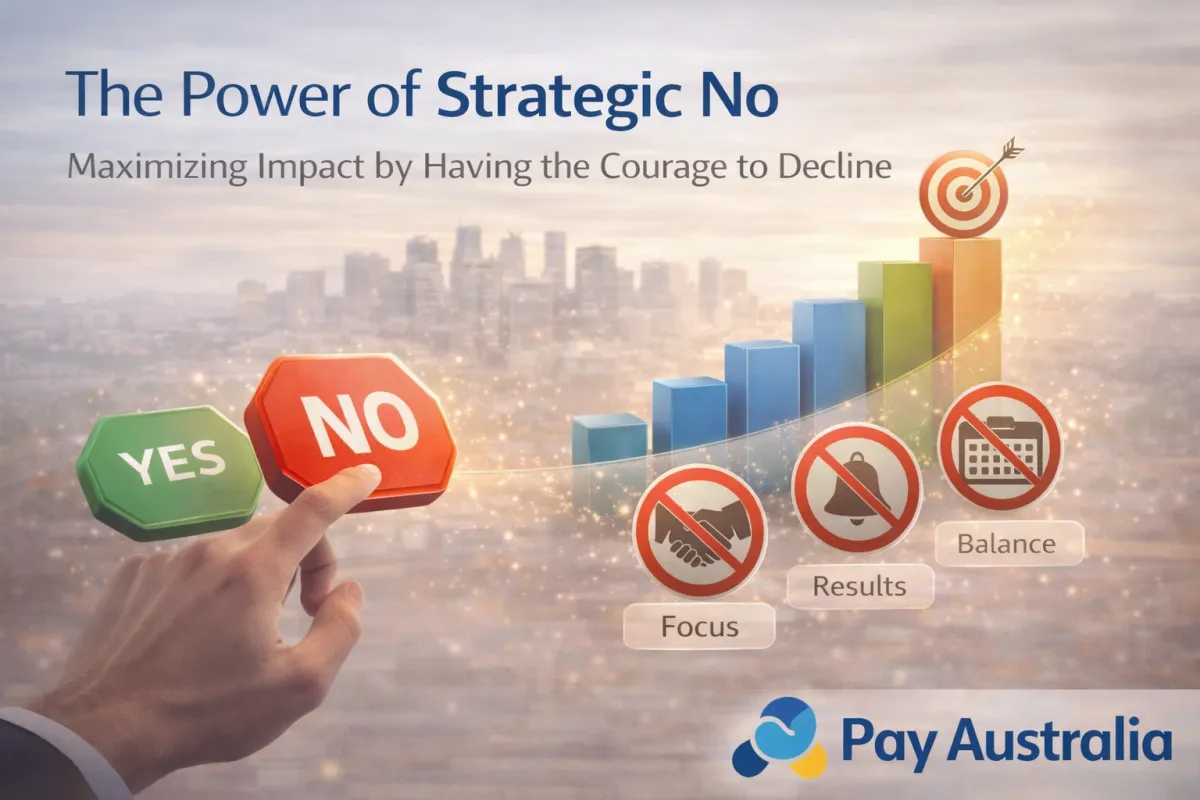
Redefining Productivity
Redefining Productivity – Why Success Often Starts with Saying 'No' More Often
How strategic selectivity creates sustainable performance while saying 'yes' to everything guarantees burnout
The Essential Idea
The conventional wisdom of professional success—maximum visibility, constant networking, accepting every opportunity—produces a predictable pattern: increased revenue alongside compressed margins, longer hours with diminishing returns, and systematic erosion of wellbeing and relationships. Research among sustainably successful professionals reveals a counterintuitive truth: they say no frequently and strategically. By establishing three core priority areas and ruthlessly declining misaligned opportunities, these professionals consistently achieve a paradoxical outcome within quarters of implementation—higher revenue with fewer working hours, improved margins through concentrated effort on high-value activities, and restored capacity for personal priorities. This isn't about doing less; it's about recognising that productivity measured by activity volume differs fundamentally from productivity measured by meaningful impact. Strategic selectivity isn't a limitation on success—it's the mechanism that enables it. The question isn't whether you can afford to say no more often; it's whether you can afford to keep saying yes to everything.
The Conventional Approach
There's a seductive logic to the conventional approach to professional growth: be visible everywhere, attend every networking event, accept every opportunity, say yes to every potential connection. The assumption is straightforward—more activity equals more success. More meetings mean more opportunities. More connections mean more potential clients. More commitments signal more importance.
This strategy works, after a fashion. Revenue might increase. Your calendar becomes impressively full. Your professional network expands. By traditional metrics, you're succeeding.
But look more closely at what's actually happening. Those revenue increases come with compressed profit margins because you're spread too thin to do any work deeply well. Those longer working hours produce diminishing returns because exhaustion undermines quality. Those impressive commitments leave no space for strategic thinking, genuine client service, team development, or personal well-being. You're busy, visible, and increasingly ineffective.
The mathematics eventually becomes unsustainable. There are only so many hours in a week, only so much cognitive capacity in a day, only so much energy in a human nervous system. When you say yes to everything, you distribute limited resources across unlimited demands. The result is predictable: shallow engagement with everything, depth with nothing.
The Counterintuitive Pattern of Sustainable Success
A different pattern emerges when you study professionals who maintain high performance over years and decades rather than burning bright and burning out.
These sustainably successful people have something in common: they say no. A lot. To good opportunities. To influential people. To things that would look impressive on their profile. They decline invitations, turn down projects, and politely refuse requests with a frequency that initially seems almost reckless.
This isn't laziness or lack of ambition. It's something more sophisticated: strategic selectivity.
They've typically identified three—rarely more than three—core priorities for their current professional phase. These might include deepening existing client relationships, developing team capabilities, and maintaining personal health. Or building expertise in a specific domain, expanding into a particular market, and preserving family time. The specific priorities vary, but the structure is consistent: a small number of clearly defined focus areas.
Everything else becomes negotiable. Not immediately rejected but assessed against these core priorities. Does this opportunity strengthen existing client relationships, develop the team, or support personal health? If not, it gets declined, regardless of how attractive it might be in isolation.
The Australian Context: Cultural Tensions Around Saying No
This strategic selectivity creates particular tensions in Australian workplace culture. We value contribution, pulling our weight, and being a good team player. There's cultural pressure to be helpful, not to let the side down, and to have a go when asked.
Saying no can feel un-Australian. It might seem like dodging responsibility or putting yourself above the team. The tall poppy syndrome creates additional complexity—too much focus on your own priorities might be seen as self-important.
But there's another Australian value that's equally relevant: respect for genuine capability and getting the job done properly. Australians have limited patience for people who are all talk and no substance, who commit to everything and deliver on nothing. We respect people who do what they say they'll do, who deliver quality work, and who maintain their commitments.
Strategic selectivity actually aligns with this second set of values. When you decline opportunities that don't fit your priorities, you're protecting your ability to deliver genuine quality on the commitments you do make. You're respecting others' time by not making commitments you can't honour properly. You're being honest about your capacity rather than overpromising.
The key is framing. "I'm too important for that" lands differently than "I want to make sure I can deliver properly on my existing commitments before taking on something new."
The Initial Discomfort of Strategic Decline
When professionals first attempt strategic selectivity, predictable discomfort emerges.
1. Fear of Missed Opportunities
What if this is the connection that leads to your biggest opportunity? What if declining this invitation means missing a crucial conversation? What if saying no today closes a door that matters tomorrow?
This fear is understandable but usually unfounded. Genuinely transformative opportunities rarely arrive through random networking events or scattered commitments. They emerge from deep relationships, developed expertise, and strategic positioning—all of which require focused attention rather than dispersed activity.
2. Concern About Professional Relationships
Won't people be offended if you decline? Won't you develop a reputation as uncooperative or difficult? Won't declining today mean they won't ask tomorrow?
Sometimes, yes. Some people will be put off. Some invitations won't be extended again. But here's what happens more often: people respect clear boundaries. They appreciate honest capacity assessment. They remember those who do say yes because those commitments are honoured properly. Your reputation becomes one of reliability rather than availability.
3. Guilt About Prioritising Personal Needs
Perhaps the most common source of discomfort: guilt about declining professional opportunities to preserve personal time, energy, or priorities. This feels selfish, particularly in cultures that valorise professional dedication.
But treating personal well-being as negotiable while professional demands are non-negotiable is a recipe for unsustainable performance. You can run on depleted reserves temporarily, but not indefinitely. Strategic selectivity means treating personal priorities—health, relationships, recovery—as legitimate constraints, not just preferences to be abandoned when professional demands increase.
What Actually Happens: The Data on Strategic Selectivity
When professionals implement strategic selectivity—typically by identifying three core priorities and declining opportunities that don't align—consistent patterns emerge.
Within one to three quarters following implementation, data shows:
1. Revenue Increases Despite Fewer Commitments
This seems paradoxical until you understand the mechanism. Scattered attention produces mediocre results across many areas. Focused attention produces exceptional results in a few areas. Exceptional results in focused areas generate more value—and more revenue—than mediocre results across many areas.
A consultant who attends every networking event might generate numerous low-value connections. A consultant who focuses deeply on existing client relationships might generate fewer but much higher-value opportunities from referrals and expanded scope with current clients.
2. Working Hours Decrease
Again, counterintuitive. Fewer commitments directly create available time. Reducing context switching reduces the hidden time tax of switching between different types of work. A deeper focus on fewer areas allows you to work more efficiently within those areas as expertise and systems develop.
Professionals implementing strategic selectivity typically report working 10-20% fewer hours within the first year while maintaining or exceeding previous output.
3. Profit Margins Improve
Revenue per hour worked increases because energy flows toward high-value opportunities rather than scattering across marginal activities. You're not just doing more valuable work—you're doing it more efficiently because you've developed deep capability in your focus areas.
The economic logic is compelling: if you can increase revenue while decreasing hours, profit margins expand dramatically. This isn't about working harder—it's about working strategically.
4. Quality and Reputation Enhance
When you're not perpetually rushed and scattered, quality improves. Client strategy becomes thoughtful rather than reactive. Deliverables reflect genuine expertise rather than hurried completion. Your reputation shifts from "busy and responsive" to "exceptionally capable in their domain."
This quality improvement creates a reinforcing cycle: better work generates better opportunities, which justify even greater selectivity, which enables even better work.
The Mathematics of Focus
The case for strategic selectivity isn't just empirical—it's mathematical.
Consider cognitive capacity. Research consistently shows that deep work—the kind that produces genuine value—requires sustained, uninterrupted focus. Context switching between different types of tasks carries significant cognitive overhead. Every time you shift from client work to a networking event to a community commitment to a different project, you lose time and energy to the transition itself.
If you're managing ten different types of commitments, you're constantly paying that switching cost. If you're managing three focus areas, the switching cost drops dramatically. The time and energy saved compound across days and weeks.
Consider relationship depth. Meaningful professional relationships—the kind that generate genuine opportunities—require sustained engagement over time. Surface-level interactions with hundreds of people produce surface-level relationships. Deeper engagement with dozens of people produces relationships with actual trust, understanding, and mutual value.
Your relationship capacity is finite. Strategic selectivity means investing that capacity where it generates actual return rather than distributing it so thinly that no relationship develops depth.
Consider expertise development. Mastery requires concentrated practice over time. If you're working across ten different domains, you develop shallow competence in all of them. If you focus on three domains, you develop genuine expertise. That expertise becomes a competitive advantage that shallow breadth can never replicate.
Practical Implementation: Moving from Theory to Practice
Strategic selectivity sounds compelling in theory. Implementation requires concrete practices.
1. Identify Your Three Core Priorities
Not five. Not seven. Three. Write them down explicitly. These should be specific enough to guide decisions but broad enough to encompass meaningful work.
Examples of well-defined priorities:
"Deepen relationships with my top ten existing clients"
"Build technical capability in data analytics"
"Maintain daily exercise and family dinners"
Examples of poorly defined priorities:
"Grow my business" (too vague)
"Network effectively" (too vague)
"Be successful" (meaningless)
Your three priorities become your filter for every opportunity, request, and invitation.
2. Create a Decision Framework
When an opportunity arises, ask explicitly: "Does this advance one of my three core priorities?" If yes, consider it seriously. If no, default to decline unless there's a compelling, exceptional reason.
This removes the need to evaluate each opportunity from scratch. You've already done the strategic thinking. Now you're just applying your established framework.
3. Develop Standard Declines
Create templates for politely declining opportunities across categories such as networking events, speaking opportunities, project requests, advisory roles, etc.
These should be gracious, brief, and honest without over-explaining. Examples:
"Thank you for thinking of me for this. I've committed to focusing on a few core priorities this year, and this doesn't fit within that scope. I hope you find the right person."
"I appreciate the invitation. My current commitments don't leave room to do this properly, and I'd rather decline than overcommit and underdeliver."
Having these templates prepared makes declining easier and more consistent.
4. Schedule Strategic Review Sessions
Quarterly, review your three priorities. Are they still the right priorities? Have circumstances changed? Are you actually allocating time and energy to them, or are you letting other commitments creep in?
This review keeps your strategy active rather than allowing it to become a theoretical commitment undermined by daily decisions.
5. Track Your Results
Document baseline metrics before implementing strategic selectivity: working hours per week, revenue, profit margins, time allocated to personal priorities, and subjective well-being measures.
Track these quarterly. The data will either validate your approach or reveal needed adjustments. More importantly, seeing concrete improvements reinforces the behaviour when guilt or FOMO tempt you to revert to saying yes to everything.
What Strategic Selectivity Isn't
To be clear about what this approach doesn't mean:
It's Not About Doing Less Overall
Strategic selectivity isn't about reducing ambition or settling for less. It's about concentrating your ambitious energy on fewer, higher-impact areas. You might actually accomplish more, just in focused domains rather than scattered everywhere.
It's Not About Being Unavailable or Uncooperative
You're not declining to be difficult or preserve your comfort. You're declining to protect your ability to deliver genuine value in your priority areas. That's professionalism, not selfishness.
It's Not Permanent or Rigid
Your three priorities should evolve as circumstances and goals change. Strategic selectivity is a discipline, not a prison. You're choosing focus, not locking yourself into unchangeable commitments.
It's Not About Avoiding Challenge
Some people interpret selectivity as avoiding difficult work. Actually, deep focus on priority areas often means tackling harder challenges with more resources rather than engaging at the surface level with easier opportunities.
The Compounding Benefits Over Time
Strategic selectivity creates benefits that compound.
Initially, you simply have more time and energy. That's valuable but fairly straightforward.
Over months, you develop deeper expertise in your focus areas. That expertise makes you more valuable, more efficient, and more differentiated.
Over the years, your focused reputation becomes an asset. You're known for specific capabilities rather than general availability. The opportunities that come to you are better aligned with your actual strengths and priorities. You spend less energy sorting through misaligned opportunities because they're presented less frequently.
The long-term result: a professional life characterised by meaningful work in areas you've chosen, sustainable performance levels, and preserved capacity for personal priorities. This isn't just more satisfying—it's more successful by almost any meaningful metric.
Addressing the Scarcity Mindset
A common barrier to strategic selectivity is scarcity mindset: the fear that opportunities are limited, that declining anything means missing your chance, that you can't afford to be selective.
This mindset is usually unfounded, particularly for capable professionals. Opportunities aren't actually scarce—they're abundant. The scarcity is in your capacity to pursue them all well.
By saying yes to everything, you're not capturing more opportunities—you're diluting your effectiveness across all of them. By being selective, you're not limiting your opportunities—you're increasing your capacity to capitalise on the right ones.
The professionals who seem to have the most opportunities are typically the most selective. They've built reputations for excellence in specific areas, which generates more and better opportunities in those areas. Trying to be everything to everyone generates shallow opportunities everywhere and deep opportunities nowhere.
The Liberation of Limits
Perhaps the most surprising outcome of strategic selectivity is psychological: it's liberating rather than limiting.
When you've clearly defined your priorities and committed to declining misaligned opportunities, decision-making becomes dramatically simpler. You're not constantly torn between competing commitments. You're not perpetually guilty about what you're not doing. You've made strategic choices, and you're living with them.
This clarity reduces decision fatigue—you're not evaluating every opportunity from scratch. It reduces guilt—you're not failing at everything because you've consciously chosen not to do everything. It reduces anxiety—you know what you're optimising for and can measure success against those clear criteria.
The cultural narrative suggests that success means keeping all options open, maintaining maximum flexibility, and never closing doors. But that approach creates perpetual low-grade anxiety: am I doing enough? Am I missing something? Could I be doing this better if I were doing something else?
Strategic selectivity offers an alternative: you've made conscious choices about priorities, you're honouring those choices through your actions, and you're achieving meaningful results in your chosen areas. That's not a limitation—that's liberation.
A Closing Challenge
Professional culture valorises busyness. We implicitly equate full calendars with importance, packed schedules with success, and constant availability with dedication. We wear exhaustion as a badge of honour and talk about being "crazy busy" as though it's an achievement rather than a warning sign.
But here's the reality: the most successful professionals over sustained periods—the ones who maintain high performance across years and decades, who preserve relationships and wellbeing, who generate genuinely meaningful work—aren't the busiest. They're the most focused.
They've recognised that productivity measured by activity volume differs fundamentally from productivity measured by meaningful impact. They've accepted that saying yes to everything means saying no to depth, quality, and sustainability. They've learned that strategic selectivity isn't about doing less—it's about doing what matters.
The research is clear and the data is compelling. Sustainable high performance comes from focus, not frenzy. Strategic selectivity isn't limiting—it's enabling.
The only question remaining is personal: What will you decline today to make space for what truly matters?
Your calendar might resist. Your colleagues might push back. Your ingrained habits might object. But your results, your well-being, and your long-term career trajectory will likely improve.
Not because you're doing less. Because you're finally doing what matters.
Frequently Asked Questions
Q: I'm early in my career and still building my professional network and reputation. Can I really afford to be selective at this stage, or is strategic saying 'no' a luxury reserved for established professionals?
A: This is one of the most common misconceptions about strategic selectivity—that it's only viable once you're established. The reality is often the opposite: early-career professionals benefit most from focus because they have the least margin for error. When you're building a reputation, quality matters more than quantity. Delivering exceptional work for three clients generates better referrals and opportunities than mediocre work for ten. Attending networking events that truly align with your target industry builds more valuable connections than scattering yourself across every possible event. The key adjustment for early career is ensuring your three priorities reflect building blocks: one might be "develop deep expertise in X domain," another "build relationships with 5-10 key people in Y industry," and the third "maintain energy and health to sustain effort." What you can't afford early in your career is developing a reputation for overcommitting and underdelivering, which is exactly what saying yes to everything produces. Strategic selectivity early actually accelerates career development by allowing you to build genuine capability and reputation in focused areas rather than shallow visibility across many. The professionals who advance most quickly aren't usually those with the longest networking lists—they're those who developed distinctive capability and built genuine relationships in strategic areas.
Q: My role requires me to respond to diverse stakeholder demands—I don't have the luxury of choosing three priorities when my job involves juggling multiple responsibilities. How does strategic selectivity work for people who don't control their own workload?
A: Even in roles with high external demands, you typically have more discretion than you initially recognise. Strategic selectivity in these contexts operates at two levels. First, within your formal responsibilities, you can still prioritise depth over breadth. If you're managing eight projects, you can make conscious choices about which receive strategic focus and which receive maintenance-level attention. You explicitly document which projects align with your three priorities (e.g., "projects with strategic importance to the organisation," "work that develops my capabilities," and "maintaining team morale") and allocate your best energy accordingly. Second, and often more importantly, strategic selectivity applies to the discretionary aspects of your role: the additional committees you join, the "extra" projects you volunteer for, the after-hours networking you attend. These discretionary commitments often consume 20-30% of professional time and energy—that's where strategic decline creates immediate impact. The final reality is that some roles genuinely don't permit sufficient selectivity for sustainable performance. If you've eliminated all discretionary commitments and your formal responsibilities still require unsustainable effort across too many areas, that's valuable information: you might be in the wrong role, or your role might be inadequately resourced. Strategic selectivity helps you identify that distinction—it's not that you're bad at time management, it's that the role itself is structured for burnout.


